Blog / Ecommerce
Meta Muse and the Rise of Agentic Shopping: What It Means for Shopify Brands
Meta's new AI agent can find a product, compare it and check out on a shopper's behalf. Every eligible Shopify store is already in it. Here's how it works, why Amazon said no, and what I'd check on a store this week.
Your next best customer may never see your homepage.
They'll describe what they want to an AI agent, approve the purchase with one tap, and an order will land in your Shopify admin from a channel your analytics has never heard of.
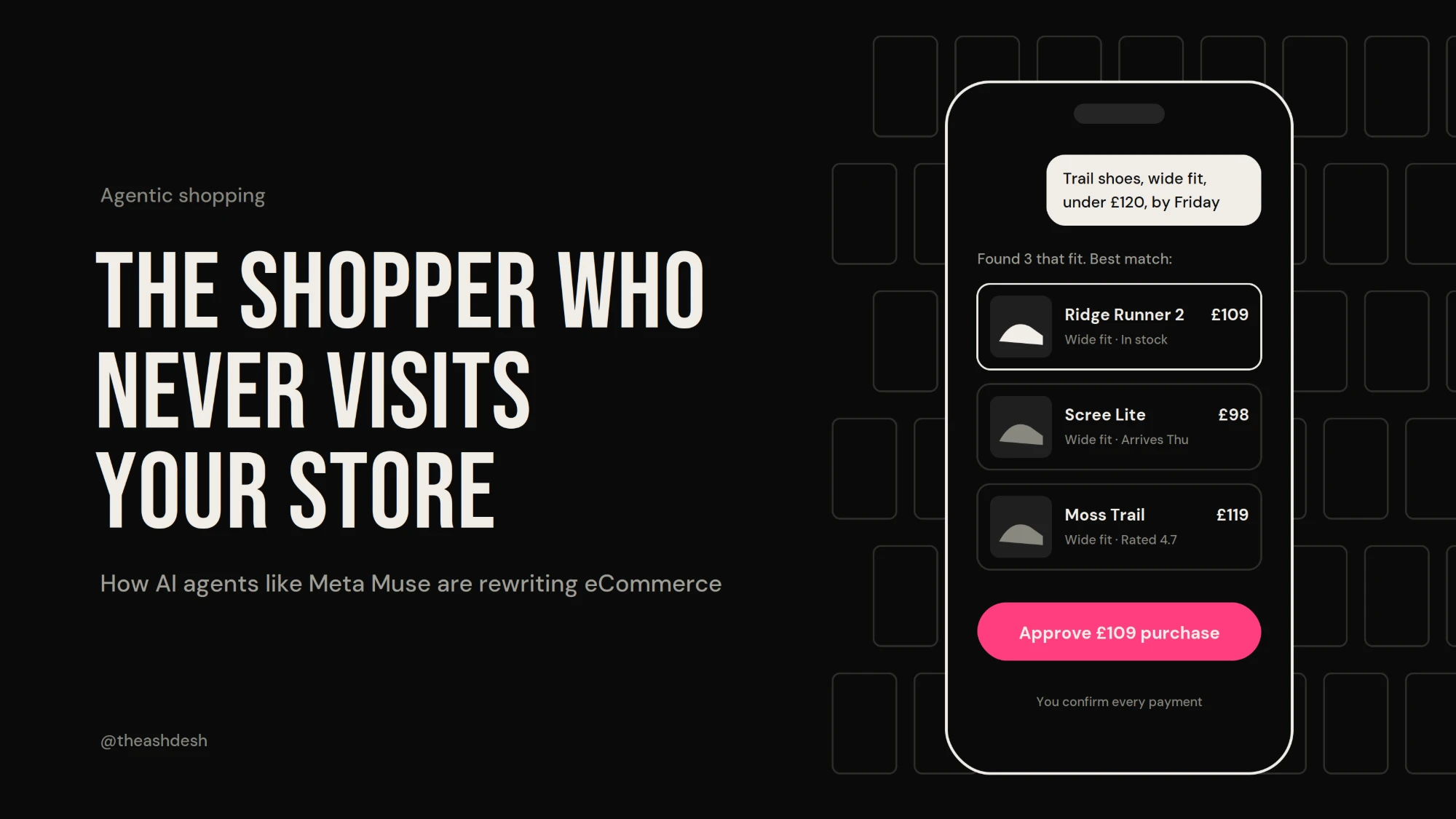
That's already happening. On 8 September 2026 Meta launched Muse, a personal AI agent that can shop on a user's behalf. Within three weeks it had gone to the top of the app stores, been blocked by Amazon, and been welcomed in by Shopify. I spend most of my working week inside Shopify, and I think this is the month agentic shopping stopped being a conference talk.
So here's what Muse is, how an agentic purchase actually works, and what I'd be checking on a store right now.
What Meta Muse actually is
Muse is an agent. You don't ask it questions so much as hand it jobs, and it keeps working on them after you close the app. Meta connects it to email, calendar, payments, dining and shopping (GeekWire).
The early numbers are big. Muse reportedly reached around 560,000 daily users within 11 days of its US launch (Sanbi). It took the number one spot for free downloads on both Apple's and Google's app stores, and Meta's share price closed up more than 11% that day (Axios).
There's a free tier, plus paid Power and Maximum plans at $20 and $100 a month (Layer3 Labs). Zuckerberg is putting it at the centre of Meta's AI strategy, with the glasses and a small keychain device called Muse Charm built around it (CNBC).
How agentic shopping works
An agentic purchase squashes the whole funnel into one conversation. There's one human step, and it comes right before any money moves.
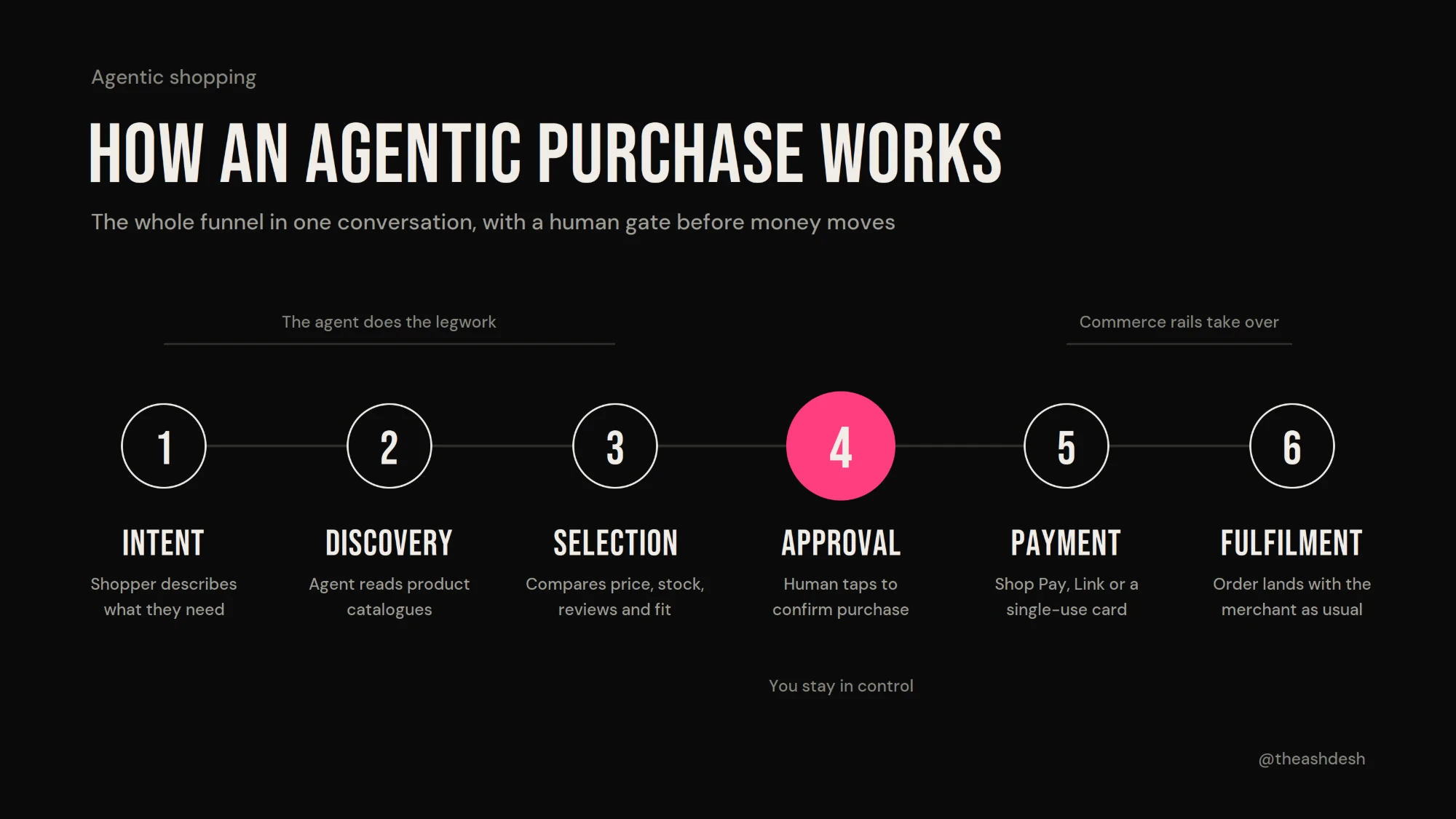
With Muse, it goes like this:
- Intent. The shopper says what they need in plain language. The agent often already knows the rest: budget, sizes, past orders.
- Discovery. Muse queries structured product feeds such as Shopify Catalog and retailer connectors. It isn't just reading web pages.
- Selection. It compares price, stock, reviews and fit, then puts forward one option or a short list.
- Approval. Checkout asks the human to approve, every time. Muse doesn't buy quietly in the background.
- Payment. Stripe Link either uses a saved payment method or issues a single-use virtual card for that one purchase, so the merchant never sees the shopper's real card (Layer3 Labs). Shop Pay and PayPal are the other rails.
- Fulfilment. The order arrives with the merchant as a normal order and ships as usual.
The retailer list is growing quickly. At Meta Connect on 23 September, Meta added shopping connectors for Walmart, Best Buy, Sephora, Ulta, Wayfair, Gap and others, plus Instacart for groceries (Sanbi).
Shopify's play: be the rails under every agent
Shopify is the quiet winner here. Every eligible Shopify store became discoverable and buyable in Muse by default. Merchants didn't have to build anything.
Three pieces make that work:
- Agentic Storefronts. A sales channel, launched in December 2025, that pushes merchant catalogues out to AI platforms: ChatGPT, Google AI Mode and Gemini, Microsoft Copilot, and now Meta (Shopify Help Center).
- Shopify Catalog. The structured product data the agents actually read. Products are shared with Meta by default (The Keyword).
- Shop Pay and the Universal Commerce Protocol. On 21 September Tobi Lütke announced a partnership so Muse can check out with Shop Pay on every Shopify store (PYMNTS). Checkout runs through UCP, Shopify's protocol for AI-driven buying (American Banker).
Two details matter if you run a store. You stay the merchant of record, and the order shows up in your admin as yours. And the checkout is different from ChatGPT's. There, the shopper finishes on your checkout in an in-app browser. With Muse, Shopify-powered direct checkout means they never leave the agent at all.
Put simply, Shopify doesn't much mind which agent the shopper talks to, as long as its catalogue and payment rails sit underneath the sale (ContentGrip).
The fight over who owns the customer
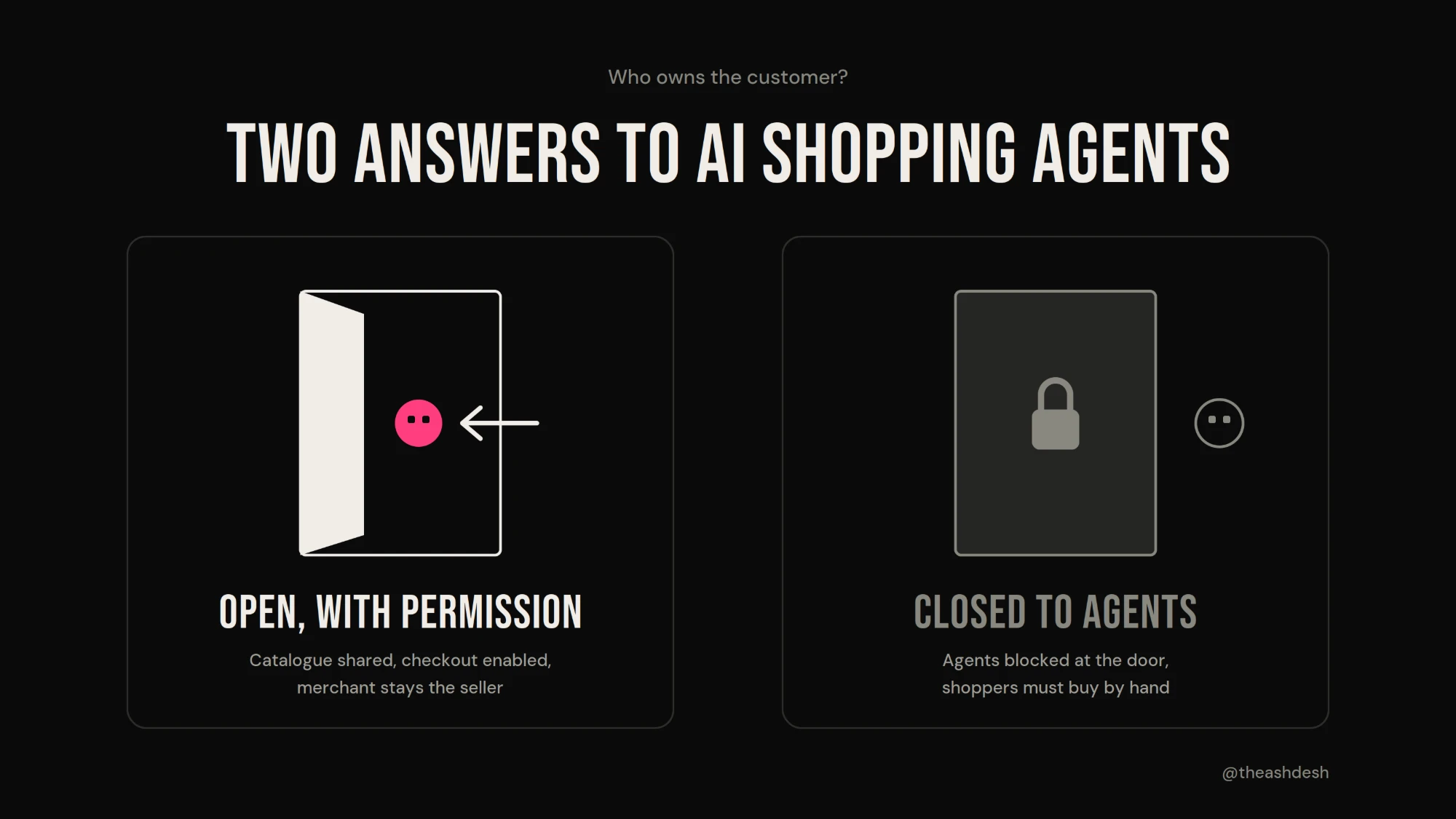
Amazon went the other way and cut Muse off from shopping on Amazon.com. Its complaints: Meta never asked, the agent doesn't identify itself when it browses, and it appears to store customer credentials (GeekWire). Meta says Muse can't see passwords or payment methods.
The security points may well be fair. But the thing actually being fought over is the start of the purchase, which is the most valuable spot in retail. Amazon has its own Alexa-based shopping assistant, and it loses out if shoppers start somewhere else (Axios). Walmart is hedging: working with Google and OpenAI while building its own agent, Sparky.
Every brand ends up with the same question. Do you own where the purchase starts, and the relationship that comes with it? Or do you just fulfil the order? Shopify has answered that for its merchants already. Open to agents, through a permissioned channel, with the merchant still recorded as the seller.
What changes for ecommerce teams
The job used to be winning the click. Now it's being the product an agent can find, trust, pick and buy. Five things follow from that.
1. Your catalogue is your storefront. Agents read titles, descriptions, variants, images, price and stock. Colour, material and size need to live as structured data, not halfway down a paragraph (Naughton & Bird). Product data used to be the boring bit of SEO. It's about to be the bit that matters.
2. CRO moves upstream. If the shopper never loads your product page, your hero banner and sticky add-to-cart do nothing. Some of the best conversion work I've done was on the product page, like putting an estimated delivery date where people could see it before checkout. An agent never sees that page. It only sees whatever delivery data you've given it. So the win happens earlier, in how the agent ranks you: clear specs, a fair price, honest reviews, clean policies.
3. Attribution breaks. Muse direct-checkout orders show up in Shopify tagged to Meta, but they never appear in browser analytics. If you're also running Meta ads, telling ad-driven sales apart from agent-driven sales is now a genuinely open question.
4. Subscriptions get an auditor. People who linked their bank statements found Muse was a sharp budgeting coach, and it cancelled subscriptions they weren't using. Recurly data says 43% of consumers are comfortable with AI managing their subscriptions (CNBC). Your retention flow now has to convince an agent as well as a person.
5. Brand loyalty gets tested. An agent comparing dozens of sites doesn't care about your logo. The brands that get picked will have an actual reason to be picked: product, price, speed or trust.
Is your store agent-ready? Eight checks
Most Shopify brands are already live in Muse, whether they know it or not. In a June 2026 PYMNTS survey only 15% of merchants had structured product data ready for agents (FirstShelf). So the bar to stand out is low.
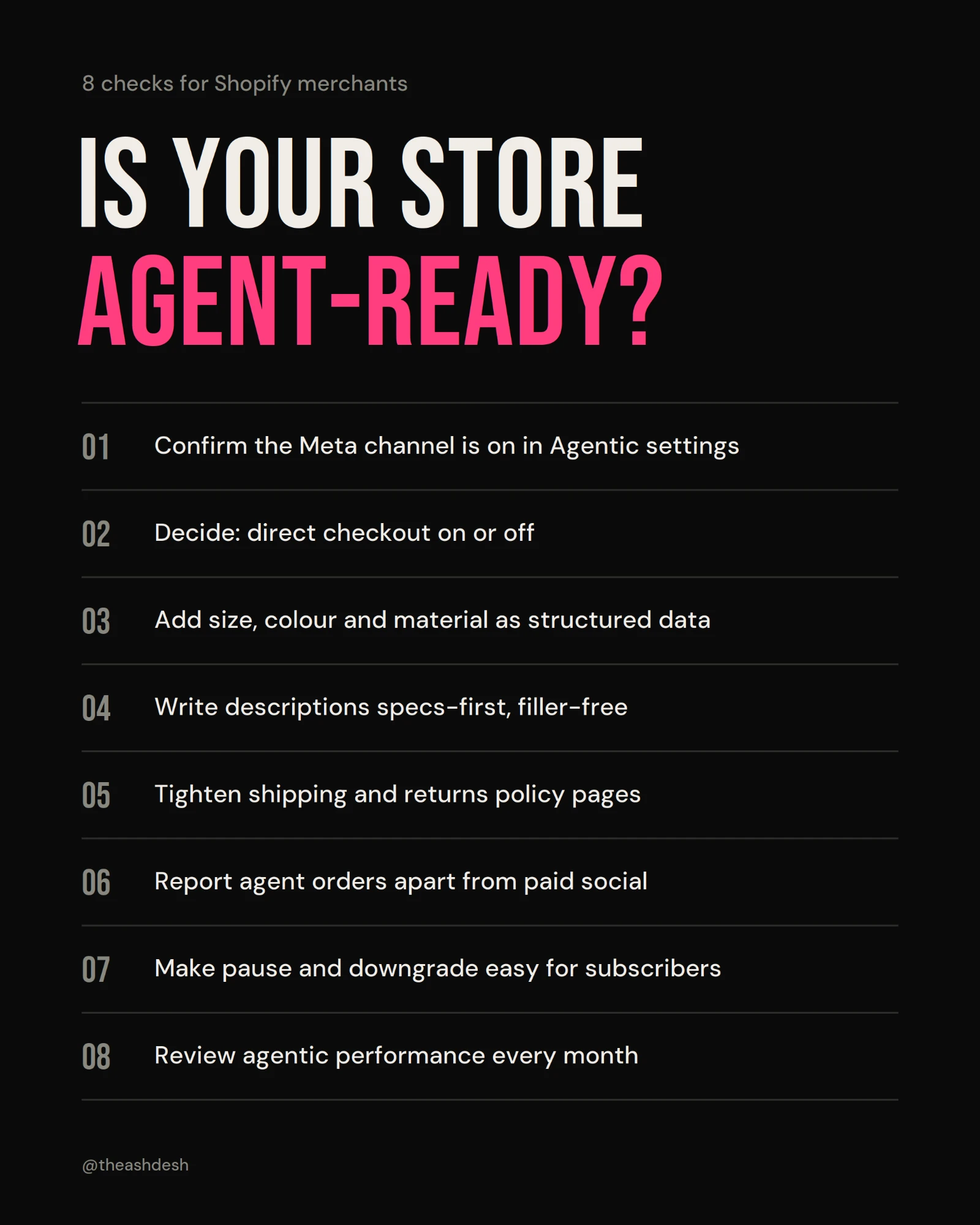
- Check the channel. Open Sales channels, then Agentic, and confirm Meta is listed with Shopify Catalog access on.
- Decide on direct checkout. On for convenience. Off if you'd rather send shoppers to your own store to finish buying.
- Audit product data. Every product needs a title, an image, a price above zero and a live URL. Add variants and attributes as structured fields.
- Rewrite descriptions for an agent as well as a person. Specs first, clear use cases, no vague marketing filler.
- Tighten the policy pages. Shipping, returns, refunds. Agents weigh trust signals.
- Report agent orders separately from paid social. Tag them, so you can see what's actually incremental.
- If you sell subscriptions, make pausing and downgrading easy. Otherwise the agent's first move is cancelling.
- Review agentic performance monthly in your Shopify admin, like any other new channel.
Reality check: adoption and trust
Muse matters, but it isn't the tipping point yet. Most people using AI shopping bots are still researching with them, not buying (Axios).
Trust is the bigger hurdle. Gartner found 64% of consumers think AI shopping agents will benefit brands more than shoppers. And Meta AI is behind: in an Emarketer survey, 33.7% named ChatGPT as the assistant they use most, against 4.7% for Meta AI (CNN). In CNN's own test, some retailers still blocked the agent from clicking through checkout.
My take is to treat agentic channels the way we treated marketplaces ten years ago. Small today. Cheap to prepare for. Very expensive to ignore once the curve bends.
The door is already open
For twenty years ecommerce has been about pulling people onto our sites and converting them once they're there. Agentic shopping turns that round. The agent turns up on the shopper's behalf, reads your data and makes its mind up in seconds.
A beautiful theme won't help much with that. What helps is product data a machine can read without guessing, and policies a person would trust. If you're on Shopify, the agent can already get in. Whether it picks you is down to what it finds when it does.
Sources
- CBS News: Muse is a hit as AI commerce takes off
- Axios: Amazon rebuffs Meta's Muse
- GeekWire: Amazon blocks Muse
- CNBC: Muse and the subscription economy
- CNN: Testing Muse
- PYMNTS: Shop Pay comes to Muse
- American Banker: Shopify adds Muse
- Shopify Help Center: Agentic Storefronts
- The Keyword: Shopify lets Muse buy
- Naughton & Bird: Muse on Shopify
- FirstShelf: Muse can buy from your store
- Sanbi: How brands get chosen by AI agents
- Layer3 Labs: Muse explained
- ContentGrip: Shop Pay and Muse