Blog / Ecommerce
Did Adobe Commerce Kill Adorn Cosmetics?
A Melbourne beauty brand says a new website cost it 30% of its sales overnight. Whose fault that is may end up being argued in court. What broke is a list every ecommerce team should know by heart.
Adorn Cosmetics, a Melbourne mineral makeup and skincare brand, is closing. Its founder, Briony Kennedy, told 7NEWS that sales dropped about 30% as soon as the new Adobe Commerce website went live, and the business never got them back (7NEWS Melbourne). At its peak, Adorn turned over around A$6m a year. Adobe declined to comment, citing legal reasons.
I've run a replatform off Adobe Commerce and onto Shopify, so I read this one twice. Not because the platform is cursed. Because almost everything Kennedy describes is something I've seen go wrong on launch day, on more than one platform.
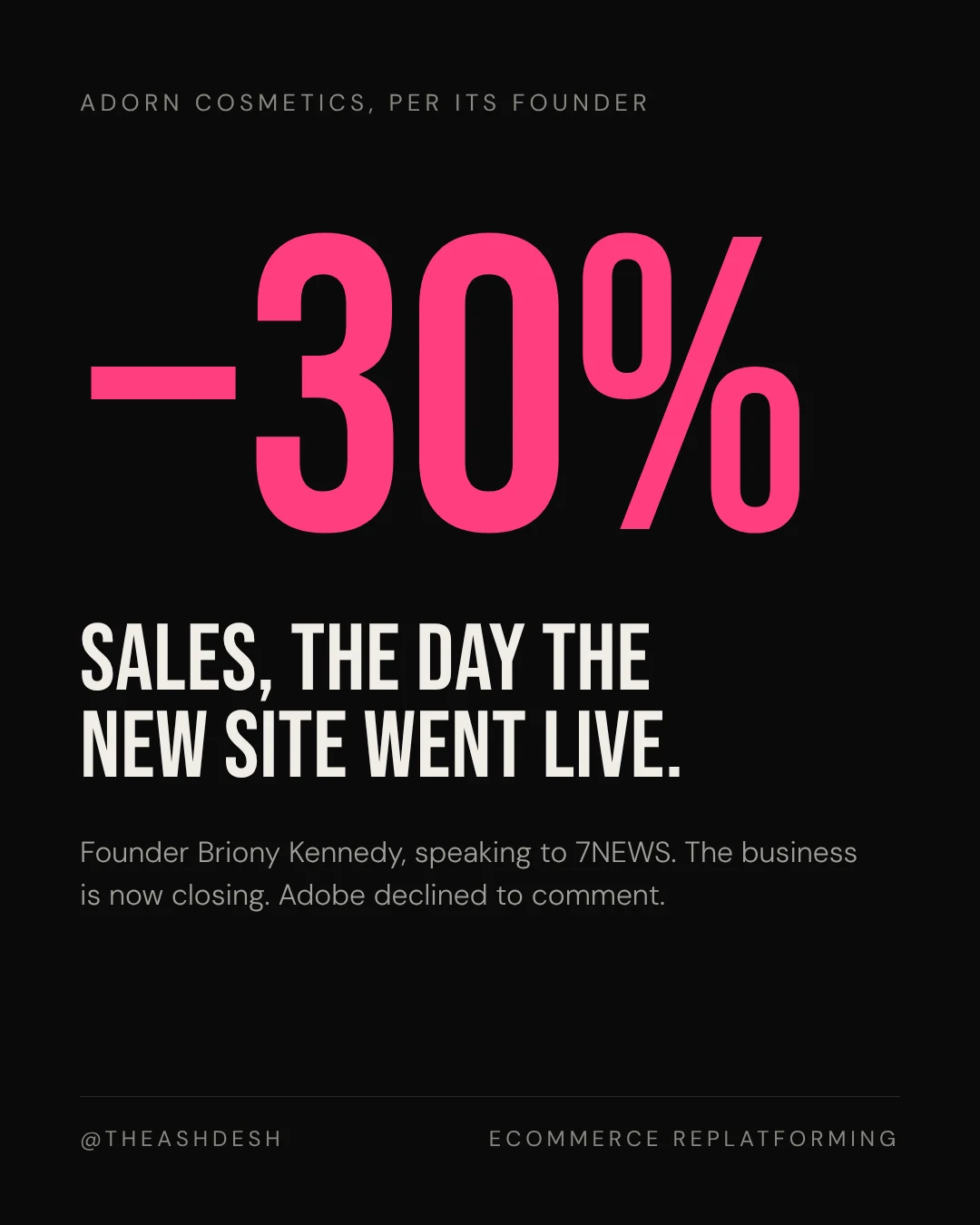
Read this as one side of the story. Everything below comes from Kennedy's interviews and public posts, and from Adobe's own 2021 case study. Neither Adobe nor the agency that built the site has given its account, and nobody outside the company has seen the numbers. That includes me, and everyone on X with a strong opinion about it.
What's on the record
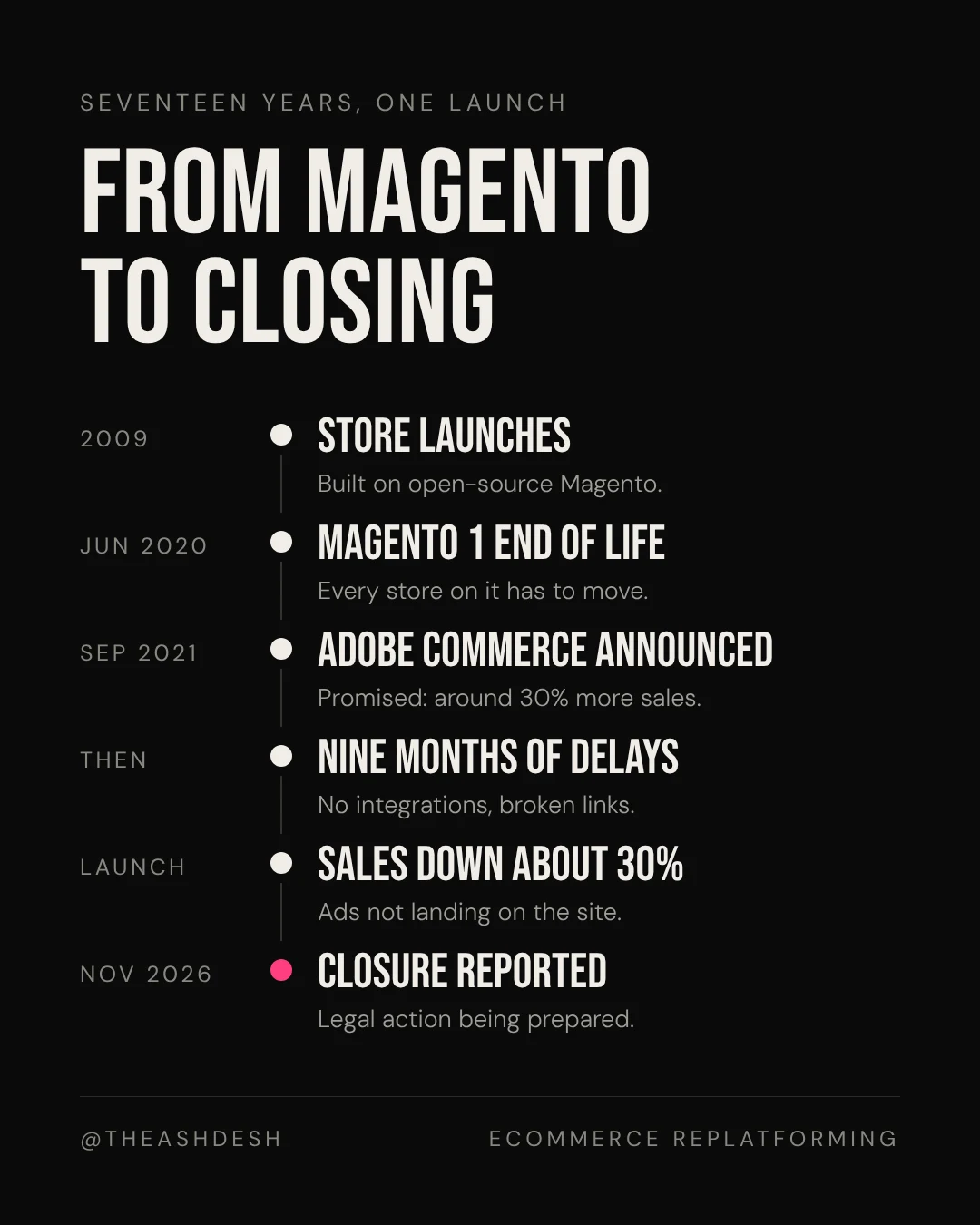
- 2009. Adorn launches its store on open-source Magento.
- June 2020. Magento 1 reaches end of life. Every store still on it has to move somewhere.
- September 2021. Adorn announces the move to Adobe Commerce. Adobe publishes a case study on the plan: search by ingredients and accreditations, personalised recommendations, a bigger loyalty programme, and live stock levels from the inventory system (Adobe).
- The promise. Kennedy says she was told to expect around 30% more sales. 7NEWS reports Adobe quoted revenue uplifts of 34% to 94%.
- What she says she got. Nine months of delays, a build with no working integrations, broken links, lost SEO, and a 30% drop in revenue (SHECOM). Her one-line version: "All of those ads that we were paying for were not linking back to the website."
- November 2026. 7NEWS reports the business is closing. Kennedy has said she is taking steps toward court proceedings involving Adobe and Convert Digital, the agency on the build.
So was it Adobe?
Probably not the software on its own. Adobe Commerce is Magento 2 with a licence and support attached. Plenty of very large stores run on it without falling over.
Look at what Kennedy actually lists, though. Broken links. Lost SEO. Ads that didn't land on the site. Integrations that weren't connected. None of those are the platform failing. They're the migration failing. You can do every one of them on Shopify too, and people do, every week.
That doesn't make the platform choice innocent. Two things about it matter.
Magento 1 to Magento 2 isn't an upgrade. It's a rebuild. New theme, extensions rewritten or replaced, customer and order data carried across. Adorn didn't choose to start a big project in 2021. Magento 1's end of life chose for them, and the project was always going to be larger than "upgrade the website".
Adobe Commerce is a lot of platform for a brand this size. A licence on top of hosting, and a specialist developer for most changes. When something breaks after launch, you're back in a queue with your agency. On Shopify, a lot of what went wrong here is fixable by an in-house marketer on a Tuesday afternoon. That's a question about fit, not fault. It's the one I'd ask first at any brand turning over single-digit millions.
There's also a gap in the story worth noticing. With nine months of delays after a late 2021 start, the launch was probably sometime in 2022. The closure is 2026. A 30% drop doesn't close a business in a week. It closes it by making every year after harder, while ad costs across DTC beauty climbed. The question I'd want answered is why the traffic wasn't recovered in month two. A broken redirect map is days of work once someone notices it. I don't know the answer, and the court case may be the first place anyone hears it.
What a 30% overnight drop usually is
When a store loses a third of its revenue on launch day, it's rarely one dramatic failure. It's several quiet ones, all hitting at once.
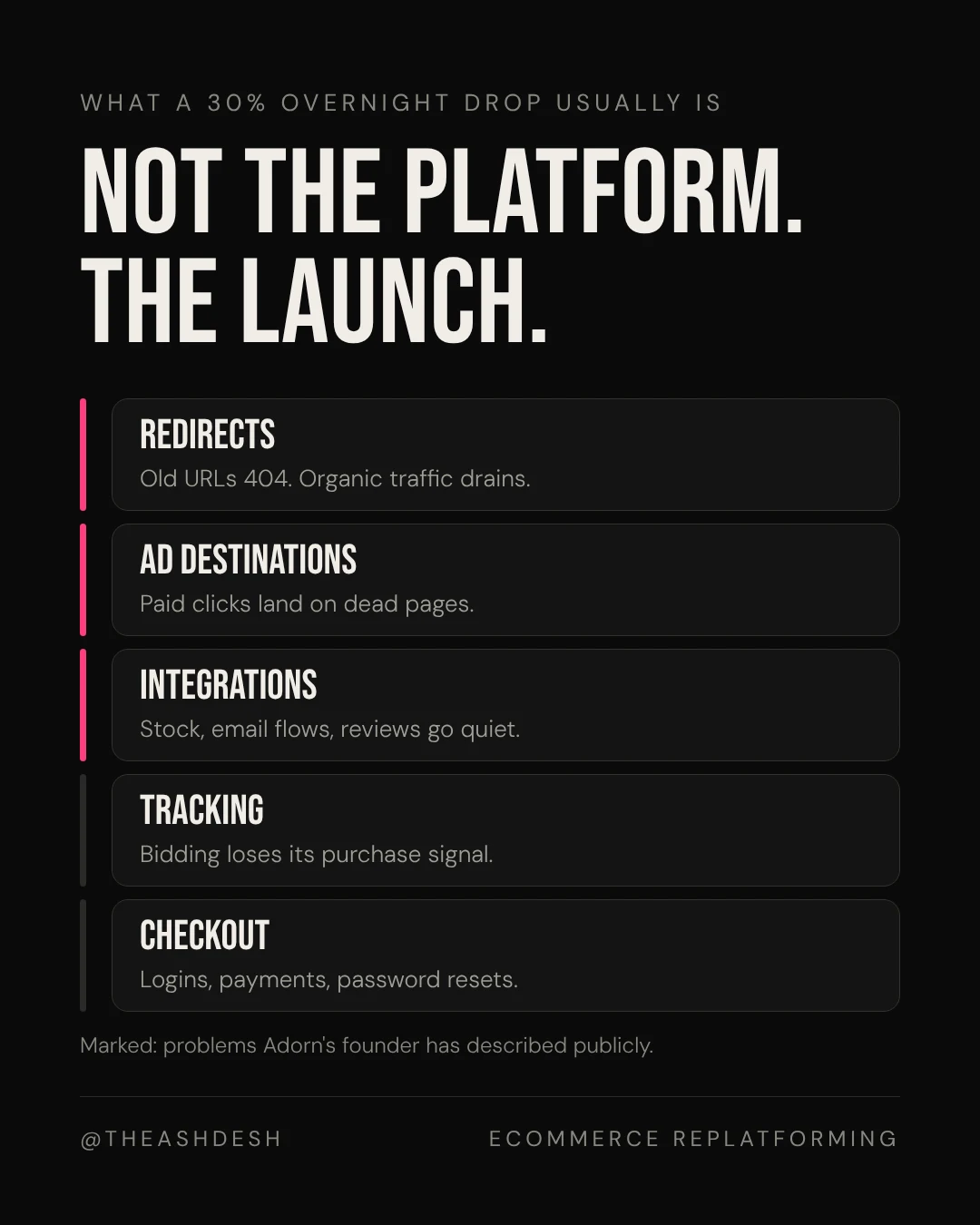
- Redirects. Every old URL that Google has indexed, that sits in an old email, or that another site links to, now goes to a 404. Organic traffic doesn't vanish on day one. It drains over a few weeks as Google drops the dead pages. That's what "lost SEO" usually means.
- Ad destinations. Shopping feeds and ads still point at the old product URLs. The ads either get disapproved or send paid clicks to an error page. Which is exactly "the ads weren't linking back to the website".
- Integrations. Stock sync, email platform, reviews, fulfilment. If stock doesn't sync, products show as sold out when they aren't. If email doesn't connect, the welcome and abandoned basket flows quietly stop. Those flows are often a big share of a beauty brand's revenue.
- Tracking. If the purchase event isn't firing, Google and Meta's bidding loses its signal and starts spending badly. Worse, you can't see the size of the drop properly, so it takes longer to react.
- Checkout. New payment setup, new account logins, sometimes a password reset for every returning customer. When we migrated at Reef, the early bugs were here. Session recordings showed us where people got stuck faster than any bug report did.
Before you migrate: seven checks
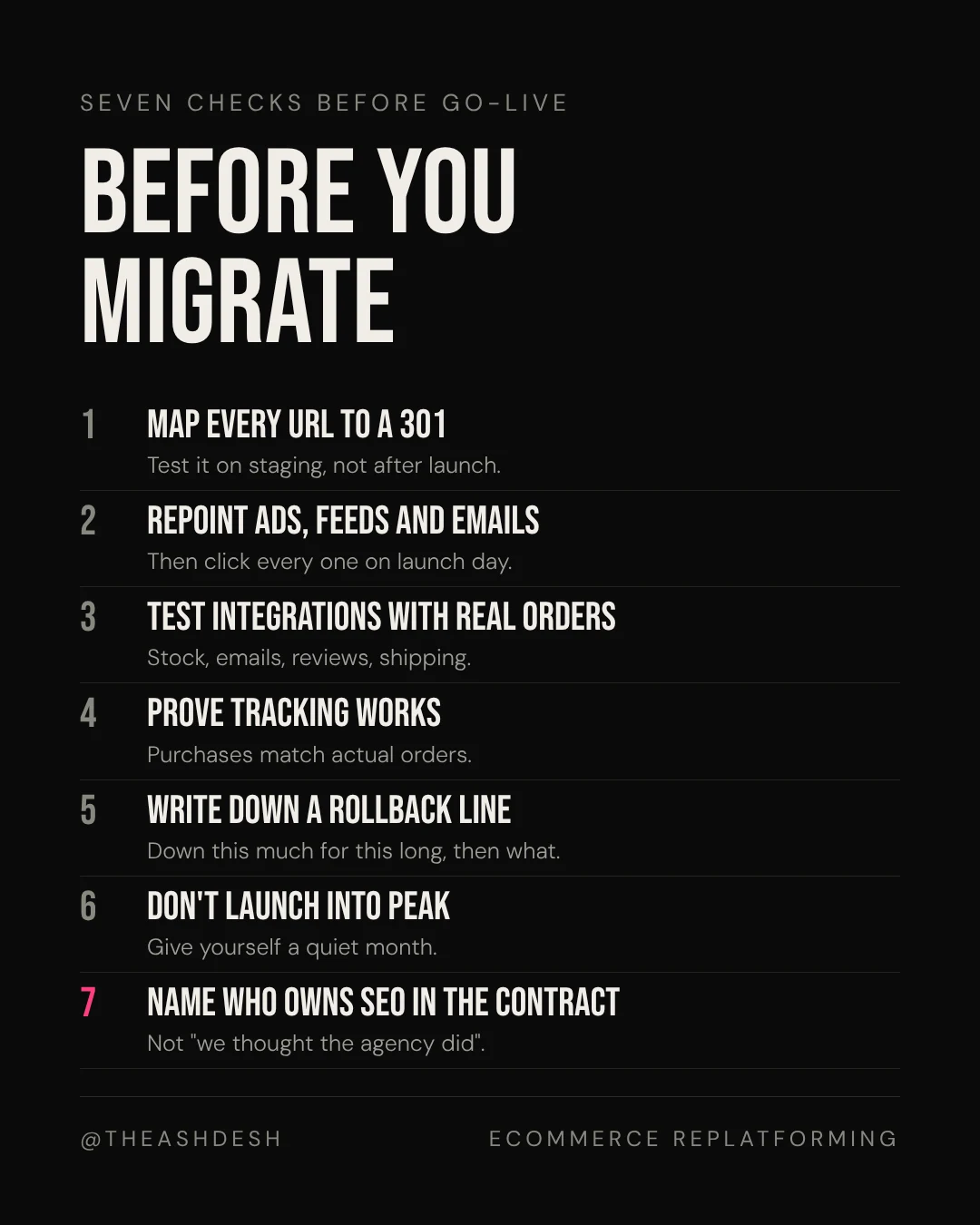
- Crawl the old site and map every URL to a 301. Products, categories, blog posts, and images if they rank. Test the map on staging, not after launch.
- Repoint every ad, feed and email link before go-live. Then click through them on launch day. All of them, not a sample.
- Test integrations with real orders. Stock goes down. The confirmation email arrives. The review request goes out. The parcel gets booked.
- Prove tracking works. Purchase events in GA4 and every ad platform, checked against actual orders before the old site is switched off.
- Write down the baseline and a rollback line. Revenue, conversion rate, organic sessions and your top 100 pages. Then agree in advance: if revenue is down a set amount for a set number of days, what happens.
- Don't launch into peak. Not before Black Friday, not before your biggest sale. Give yourself a quiet month to find what broke.
- Name who owns SEO and tracking in the contract. If the answer turns out to be "the agency thought you did", that's where the 30% went.
The takeaway
Platforms don't lose sales. Launches do. Adobe Commerce, Shopify and everything else will all happily serve a 404 to your best customer if nobody mapped the URL.
If you run ecommerce for a brand, pick a platform you can afford to fix without calling someone. Then treat the launch as the riskiest day of the project, not the finish line. I feel for Kennedy. Seventeen years of building a brand shouldn't hinge on a redirect spreadsheet, and the frustrating part is how often it does.